Table of Contents
- Introduction
- The Notion of Home
- Changing Definitions of Home in Japan
- Anne’s Home, Green Gables
- 1950s Japan: The Publication of Muraoka’s Akage no An and Three Other Touchstone Books for Young People
- Emily’s Home, New Moon Farm
- Walter’s Home, Ingleside and Rainbow Valley
- The Timeframe of the Japanese Translations of Emily of New Moon and Rilla of Ingleside
- Home as a “Frontier”
- Conclusion
Considering the multiple meanings of “home” and “identity,” this paper analyzes how “home” and the domestic duties associated with it affect three Montgomery characters: Anne Shirley, Emily Byrd Starr, and Walter Blythe, as seen from a Japanese reader’s perspective. Close attention is given to Green Gables and its three inhabitants.
Introduction
In her fiction, L.M. Montgomery describes the close relationship between one’s home and one’s identity. This paper will mainly focus on Anne’s home of Green Gables, compared with Emily’s home of New Moon and Walter’s homes of Ingleside, Rainbow Valley, and Canada as a nwation. These special places teach each character how to overcome their identity crises in their younger days. Identity is a fundamental concept which develops throughout the cycle of one’s life. Erik H. Erikson explains that identity consists of “group identity” and “ego identity”: in one’s childhood, one builds self-esteem by engaging and interacting with one’s surrounding groups such as family and community, and, ideally, in one’s adolescence, this self-esteem develops into “a well-organized ego within a social reality,” becoming one’s “ego identity.” Erikson emphasizes: “Ego identity … is the awareness of the fact that there is a self-sameness and continuity to the ego’s synthesizing methods, the style of one’s individuality, and that this style coincides with the sameness and continuity of one’s meaning for significant others in the immediate community” (Erikson 45–50). It is true that Anne, Emily, and Walter each achieve their “ego identities” through their participation in and interaction with their various relationships with others, including family members, friends, and the community. Considering the multiple meanings of “home” and “identity,” this paper will analyze how “home” and the domestic duties associated with it affect three Montgomery characters—Anne Shirley, Emily Byrd Starr, and Walter Blythe—as seen from a Japanese reader’s perspective.
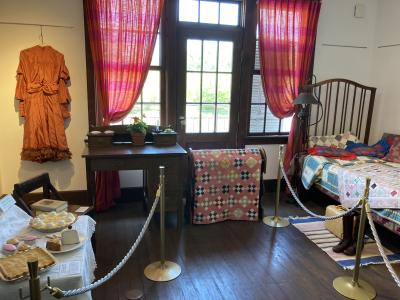
In 2024, the 150th anniversary of Montgomery’s birth was celebrated enthusiastically in Japan; various events such as exhibitions, musicals, a ballet, and lectures were held throughout the year (Akamatsu, “Celebrating”). The well-known anime character of Anne Shirley created in 1997 was the campaign “girl” of the foster-family system sponsored by the Japanese government, Kodomo Katei-chō (Children and Family Agency) (Kodomo Katei-chō, “Sato-oya Seido”). There was also an exhibition titled Red-haired Anne and Karuizawa (27 April to 2 June 2024) held in a Western-style house named Suikyusō in the resort town of Karuizawa; its purpose was to help Japanese fans imagine Anne in the Japanese countryside in a representation of her physical home of Green Gables (“Suikyusō”). Karuizawa is where the first Japanese translator of Anne of Green Gables, Hanako Muraoka, spent summers during her school days at the Christian Tōyō Eiwa Women’s school. The principal, Miss Isabella Skade Blackmore “opened her own cottage [named ‘Brookside Cottage’] to missionaries and dorm students who could not go home for summer holidays. This was where Hanako had spent every summer since entering Toyo [sic] Eiwa” (Eri Muraoka, Anne’s Cradle 76; Hanako Muraoka, “Summer Greetings” 64). Her time spent in Karuizawa began in the early 1900s, during her school days, when she was Hanako Annaka (Hirokawa 26). Later, after marrying Keizo Muraoka, she spent summers there with her new family in the Muraoka family villa, though her granddaughters do not know when or by whom the cottage was purchased.1 It is well known that Muraoka was given a copy of Anne of Green Gables by her Canadian missionary friend, Loretta Shaw, who also spent summers in Karuizawa, in her own summer residence. It is interesting to note that the climate of Karuizawa in early summer resembles that of Prince Edward Island in June. Based on these connections, the exhibition rooms were furnished with items connected to the interior of Green Gables, attracting thousands of Japanese visitors, and proving once more the continuing popularity of Anne of Green Gables (Hirokawa 26–29). The popularity of the exhibition suggests both the Japanese readers’ interest in Western architecture, and their understanding of the importance of the concept of a physical and metaphorical home for the protagonist.
Green Gables is a fictional farmhouse where brother and sister Matthew and Marilla Cuthbert live and open their home to an orphan named Anne Shirley. In the 1930s, the Canadian government decided to use the home of one of Montgomery’s relatives as a model of Green Gables and made it part of Prince Edward Island National Park. It is situated near Montgomery’s Cavendish home where she was brought up by her maternal Macneill grandparents. This Green Gables farm has been a pilgrimage site for ardent Montgomery fans from all over the world, including Japan, helping them to imagine how Matthew, Marilla, and Anne lived their daily lives. The original house was a typical nineteenth-century Prince Edward Island farmhouse referred to as an “Island Ell,” which typically has a large main section and a smaller wing off to the side (Kamikawa 41–43).2 As Alan MacEachern explains, Green Gables was transformed from a typical Island farmhouse into the idyll of Montgomery’s imagination. In 1938, the Webb family, Montgomery’s relatives who then lived there and welcomed tourists, renovated the original farmhouse, which included painting the gables green (151–52). After the Webbs left the farm, the Canadian National Park Service recreated its interior, as well as the landscape surrounding the farm, to more faithfully portray Green Gables as it is described in the book. The Japanese efforts of decorating the house in Karuizawa for the 2024 exhibition had the Canadian model to follow as an example.
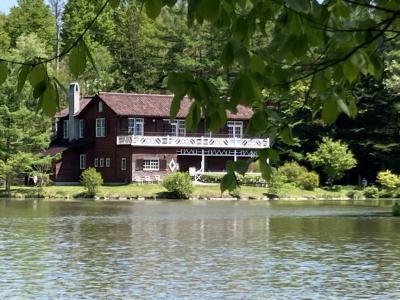
The Anne exhibition in Karuizawa draws attention to the Japanese affinity for westernization that was manifest in Japan before World War II. Suikyusō (Sleeping Dove’s Cottage), where the recent Anne exhibition was held, was designed in 1931 by a famous American architect and Christian lay missionary, William Merrell Vories (1880–1964), for a wealthy businessperson, Seikichi Asabuki. It was built as Asabuki’s summer house, complete with gables and a big English-style living room with a hearth. The gabled exterior of the house does not resemble Green Gables farmhouse, but, for the exhibition, one room inside the house was decorated just like Anne’s in the model Green Gables house in PEI, which delighted the Japanese Montgomery fans who visited, and other rooms displayed photos of Prince Edward Island and books written by Montgomery and translated by Muraoka. The cottage itself was already well known because Seikichi Asabuki’s daughter Tomiko, a respected translator of French literature,3 loved the house and wrote essays about it. This shows the common trend, before the World War II, among some wealthy Japanese people, to incorporate Western architecture in their lives. These early Western-style homes were quite different to the traditional houses of ordinary Japanese people with tatami mats and sliding doors. Nowadays, however, modern Western-style houses are the standard for ordinary Japanese people.4
The Notion of Home
In his book The Politics of Home, Jan Duyvendak categorizes the notion of home into “four spheres: the sphere of the individual household, the economic sphere of the workplace, the associational sphere of the community, and the politico-cultural sphere of the nation state” (111). Though Duyvendak bases his theory on homes in Europe and the United States, his categorization of these spheres can also be applied to Canadian and Japanese homes. Based on his idea, it is the sphere of the individual household that I will mainly discuss in analyzing the homes of Anne, Emily, and Walter. In addition, while analyzing Walter, I will discuss the politico-cultural sphere regarding his decision to enlist in the World War I.
The meaning of “home” is defined by various Montgomery characters in her works. For instance, in Walter Blythe’s poem “My House,” in the posthumous work The Blythes Are Quoted, a “home” is a complex place embodying the dichotomy of life (joy and sorrow, birth and death) and is shaped by the years. As the poem concludes: “[I]t needs many things for a house to be home!” Anne tells Gilbert that Walter is describing their home, Ingleside (441–42). In Anne’s House of Dreams, just before Anne’s wedding is held in Green Gables, Marilla Cuthbert says that Anne’s wedding will turn the farm into a “real home” for the first time (6). In other words, it is the inhabitants’ experiences that metamorphose their houses into homes.
As Rea Wilmshurst explains in her introduction to Akin to Anne: Tales of Other Orphans, “Montgomery pictures homes in the country, homes loved and homes longed for” and sometimes her characters are attracted by the look of a house and come to love it. Wilmshurst argues that Constance Foster’s experience in the short story “Her Own People” (1905) shows that “love of place precedes love of people,” and “both loves culminate here [in a home in the country]” (Introduction 11). Montgomery consistently shows her love of “homes in the country,” as is evident in Green Gables, New Moon, and Ingleside. Mary Beth Cavert rightly points out that “Half of her book titles were formed with ‘[a person] of [a place],’” and Anne of Green Gables (1908), Rilla of Ingleside (1921), and Emily of New Moon (1923) are three of ten such books. It is true that “The title of Anne of Green Gables is purposeful, for it ties the main character to a specific place and identity” (Cavert, “The House of Home”). In other words, Montgomery saw “home” as a central component to identity, in keeping with Erikson’s concept of the interactions that shape ego formation. One needs one’s own space to become oneself and the author provides such space to Anne, Emily, and Walter.
Changing Definitions of Home in Japan
Muraoka was an active participant in the changing definition of “home” in Japan, through her translating and writing. Originally, the Japanese word for “home” was “ie” (家), meaning a patriarchal “family system,” in which the men presided over the household. In 1898, during the Meiji Era (1868–1912) the government officially codified the concept of ie into law (Meiji Civil Code: Family System) which remained in place until the Civil Code was amended with the Constitution of Japan and the family system was abolished in 1947 after World War II (Ronald and Alexy 1, 3–4). Also during the Meiji Era, the westernized concept of “home,” translated as “katei” (家庭) in Japanese, was newly introduced by foreign missionaries and Japanese Christians who had studied abroad in Western countries. Unlike “ie,” the word “katei” encompasses the concepts of both “home” and “family,” focusing more on the individuals within the home, rather than on the “household” as a hierarchical institution.
“Katei” novels for children, featuring women and children in their homes, began to be published in the Meiji Era. Translator Hanako Muraoka hoped to increase the audience of such books to include Japanese people of all ages. As Muraoka’s granddaughter Eri writes, “[Hanako] was determined to spread fresh, wholesome literature that could be enjoyed by children and adults alike in Japan.” In 1917, working as an English teacher at Yamanashi Eiwa Girls School, Muraoka published her first book, Rohen (Fireside), a collection of thirteen short stories, twelve of which were translations, and one of which was written by Muraoka herself. “The title encapsulated Muraoka’s image of her pupils’ happy families as they gathered around the warm hearths in their farmhouses” (Eri Muraoka, Anne’s Cradle 90).
When World War II broke out, the Japanese government utilized the family system to promote militarism. The National Family theory was based on the concept that the Japanese Emperor was the “father” of Japan, and Japanese people were his “Sekishi” (which literally means “babies,” but metaphorically means “children”). Under such a policy, Japanese citizens had a familial obligation to obey their “father’s” decision to go into battle. Six years after entering the war, when the emperor finally declared Japan’s unconditional surrender, he asked his Sekishi (children) to follow his decision.5 Japan’s devastating defeat and the ravaged state to which the country was reduced as a result led to the dissolution of the patriarchal family system and the National Family theory. After World War II, Article 24 of The Constitution of Japan (drafted on 3 November 1946 and coming into effect on 3 May 1947) stated that the family should be built on the foundation of an equal partnership of a husband and a wife, and their children.6 Japanese people were in favour of this new definition of family, which recognized the actuality of the individual under the name of democracy (Honda 160–74). The democratic family would be based on the equality of men and women, while still preserving a division of roles in society based on gender differences. Muraoka’s translation of Red-haired Anne was welcomed as it portrayed a family based on the equal partnership of two siblings who would act as parents to a child.
Anne’s Home, Green Gables
In the original story, when eleven-year-old orphan Anne Shirley learns that she has been placed in Green Gables, she says to herself, “it’s a million times nicer to be Anne of Green Gables than Anne of nowhere in particular” (AGG 54). Having a home and being given her own room for the first time in her life, there are several scenes in which Anne expresses the sheer pleasure of having a place to call home, and they occur when she is returning to Green Gables from elsewhere. Elizabeth Epperly writes that Montgomery effectively sets some of Anne’s key moments “in sunset,” but her analysis does not include Anne’s pleasure in homecoming (Epperly, Fragrance 32–33). It is often in scenes set in the early evening just before sunset and the dusk after sunset that she strongly recognizes that she has her own home to which she is heading. For instance, readers remember that Anne correctly guesses which house is Green Gables when she approaches it for the first time:
The sun had set some time since, but the landscape was still clear in the mellow afterlight. To the west a dark church spire rose up against a marigold sky. Below was a little valley and beyond a long, gently-rising slope with snug farmsteads scattered along it. From one to another the child’s eyes darted, eager and wistful. At last they lingered on one away to the left, far back from the road, dimly white with blossoming trees in the twilight of the surrounding woods. Over it, in the stainless southwest sky, a great crystal-white star was shining like a lamp of guidance and promise. (24)
The description of the landscape and of the first star shining above Green Gables is a harbinger of this orphan’s happy future. Anne points to the house and says to Matthew: “[J]ust as soon as I saw it I felt it was home” (24). From this first evening scene, we recognize that the time of day and notion of home are connected.
Another time, after apologizing to Mrs. Lynde for losing her temper because she had criticized Anne’s looks, “Anne came out of the fragrant twilight of the orchard with a sheaf of white narcissi in her hands” and returned to Green Gables with Marilla (65). When they almost reach home, “[f]ar up in the shadows a cheerful light gleamed out through the trees from the kitchen at Green Gables. Anne suddenly came close to Marilla and slipped her hand into the older woman’s hard palm.” Anne then expresses her happiness, saying, “It’s lovely to be going home and know it’s home … I love Green Gables already, and I never loved any place before. No place ever seemed like home” (66). This time is significant for Marilla herself, as she first feels “something warm and pleasant,” what the narrator calls “a throb of the maternity she had missed, perhaps” (66–67). Later in Chapter XXIX, even though she was thrilled by the buzz of city life in Charlottetown at Miss Josephine Barry’s, Anne finds “the drive home … pleasanter, since there was the delightful consciousness of home waiting at the end of it. It was sunset when they passed through White Sands and turned into the shore road” and being welcomed by “the kitchen light of Green Gables,” Anne expresses her joy saying, “it’s good to be alive and to be going home” (191). After supper with Matthew and Marilla, she emphasizes her feelings again: “I’ve had a splendid time, … and I feel that it marks an epoch in my life. But the best of it all was the coming home” (191).
Even as a teenager, it is during scenes set in the evening that Anne continues to express her gratitude for having a home. After graduating from Queen’s Academy and winning the Avery Scholarship, Anne returns home after “her good day” visiting the old familiar places and “finally in the evening she went with Matthew for the cows, through Lover’s Lane to the back pasture. The woods were all gloried through with sunset and the warm splendor of it streamed down through the hill gaps in the west” (232). That night, Matthew tells her, “I’d rather have you than a dozen boys, Anne … Well now, I guess it wasn’t a boy that took the Avery scholarship, was it? It was a girl—my girl—my girl that I’m proud of” (232). As the narrator tells, “Anne always remembered the silvery, peaceful beauty and fragrant calm of that night” because “[it] was the last night before sorrow touched her life” (233). Thus, at the time between sunset and night, Anne recognizes the feeling of belonging and the happiness of having a home.
The sense of belonging gives Anne confidence in herself. Teaching Anne to be a contributing member of the household, Marilla assigns Anne such domestic duties as patchwork, washing dishes, and collecting eggs (78–79, 80, 110, 34, 48, 124, 175). As Anne grows up, Marilla drills her in baking and table-setting (104, 171). According to Erikson, children develop more fully with “the sense of industry,” “a sense of being able to make things and make them well and even perfectly” (Erikson 123), so domestic duties play an important role in aiding a child’s development. It is Marilla’s hope not only to teach Anne what is expected of women in a household, but also to make her feel she is a true member of the Cuthbert family. Marilla’s endeavours to fashion Anne into “her model little girl of demure manners and prim deportment” hardly make progress, but, ironically, it is when Marilla finally accepts Anne as “impulsive” and imaginative that she realizes that Anne has turned out to be “smart” as well as “steady and reliable” (145, 200). Perhaps Marilla herself comes to see that when Anne is allowed to be herself in the process of her identity formation, Anne is also able to become what Marilla had hoped for all along. This process shows that one’s identity is truly formed at home and through participating in the work required to maintain it. It is also worth remembering that Marilla urges Anne to go to Queen’s Academy to get a teacher’s licence, with her forward-thinking opinion, “I believe in a girl being fitted to earn her own living whether she ever has to or not. You'll always have a home at Green Gables as long as Matthew and I are here, but nobody knows what is going to happen in this uncertain world, and it’s just as well to be prepared” (195). Marilla’s clear belief gives Anne the choice of going to university or earning her own living with her teacher’s licence. As Mary Rubio and Elizabeth Waterston comment, “Marilla takes a stand contrary to accepted Avonlea convention that education is not necessary for women” (AGG 195–94). Without her family’s support, Anne would not have had the luxury of further education to explore her future, and Anne does her best when she is given the chance to study.
It is young Anne who transforms Green Gables from a painfully neat house to a comfortable home. She influences Matthew and Marilla’s straightforward but conventional lifestyle and adds unexpected joy and beauty to their everyday lives. Sharing their grief over Matthew’s untimely death, Anne and Marilla recognize their deep love as a family. Anne describes the bitterness of losing Matthew as “our sorrow—yours and mine,” while Marilla tells her true feelings to Anne for the first time: “I love you as dear as if you were my own flesh and blood and you’ve been my joy and comfort ever since you came to Green Gables” (235). Sharing grief, Anne and Marilla strengthen their bond as a family and their love for their home. Green Gables is not only their precious house but also the place in which Anne’s identity is firmly based. She is, after all, Anne of Green Gables, what she has always striven for and wanted to be.
Anne’s decision not to go away to university is made not only to save Green Gables from being sold and to help Marilla, but also for Anne herself to be able to stay where she belongs. She says to Marilla: “I’m heart glad over the very thought of staying at dear Green Gables. Nobody could love it as you and I do—so we must keep it” (241). Having forged her identity there, Anne now wishes to responsibly contribute to her family and home. Erikson emphasizes adolescence as a significant life stage in the development of one’s identity (Erikson, 128–34), so it is appropriate that, at the age of sixteen, the once-homeless Anne becomes Anne of Green Gables in both name and reality.
1950s Japan: The Publication of Muraoka’s Akage no An and Three Other Touchstone Books for Young People
Muraoka’s Japanese translation of Anne of Green Gables was published in 1952, seven years after the end of the World War II. When Hanako Muraoka published the first Japanese translation of Anne of Green Gables as Akage no An (Red-haired Anne), she thought it would be impossible for Japanese readers at that time to imagine a house “with a gabled roof” and so her title focused on the unique physical characteristic of the protagonist (Eri Muraoka, Anne’s Cradle 214). In Japan, especially in Japanese theatre since the Meiji era, the term “red hair” was an umbrella term for Western hair colour—including blond and brown—in contrast to the black hair of Japanese people. This term carried no connotations of discrimination or prejudice. Rather, Japanese readers felt affection for this orphan with a complex about her appearance, looking on sympathetically as she grew in confidence, and witnessing her deepening love for the home and family that accepted her.
In the same year as the first publication of Akage no An (Red-Haired Anne) (1952), several other novels featuring child protagonists were published, all of them leaving a lasting impression. In 1952, female novelist Sakae Tsuboi (1899–1967) published Nijyū-shi no Hitomi (Twenty-four Eyes), which tells the story of a young elementary school teacher and her twelve pupils (five boys and seven girls) over the course of almost twenty years (from 1928 to 1946), including the years of the World War II. This book describes the politico-cultural sphere of those years in Japan. In a rural area of western Japan, Onishi-sensei (Miss Onishi) encourages her pupils to study and enjoy their school life, but poverty and war prevent most of them from continuing their studies. She eventually resigns from her position, unwilling to promote the government’s policy of militarism and allegiance to the war efforts. A few years later, after marrying and having children of her own, she has a chance to meet with her former pupils. She softly tells the young men as they are heading off to fight for Japan, “Don’t die an ‘honorable death.’ Come home alive” (188). Onishi-sensei expresses her anti-war beliefs, which was unusual at that time in Japan. Her husband dies in the war, as does one of her three children, her only daughter, who dies of food poisoning brought about by the extreme conditions of the war. Three of her former male pupils are killed in battle, one is wounded and loses his sight, and only one boy survives unscathed; five out of seven girls survive. At the end of the novel, Onishi-sensei, who has returned to teaching, attends a reunion with the seven remaining students of the original twelve. All eight of them recall the innocence of their youth and their old bonds. This novel reflects the devastating impact the World War II wrought on the ordinary, vulnerable citizens of Japan, including its children.
In 1952, Japan was only seven years removed from the horrors of the World War II during which Japan itself was a battlefield. Sakae Tsuboi’s novel, and Onishi-sensei’s anti-war sentiments within, resonated with a nation still struggling to recover. The synchronous timing of the publication of Tsuboi’s novel and of Muraoka’s translation of Anne of Green Gables left Japanese readers longing for the peaceful innocence of the world brought to life in the latter.
It is also interesting to note that bookending the publication of Red-haired Anne and Twenty-four Eyes in 1952, the American classic, The Wonderful Wizard of Oz (1900) by L. Frank Baum was first introduced in Japan in 1951 under the simplified title The Wizard of Oz, and in 1953 the French classic The Little Prince (1943) by Antoine de Saint-Exupéry was first published in Japan under the title The Prince from a Star (Zusetsu 110, 112, 114). Both books, like Anne of Green Gables, focus on the search for one’s identity and the importance of home. In the former, Dorothy discovers her own inner strength and learns the significance of home; and in the latter, the prince learns that what is most valuable can be seen only by the heart, as it is invisible, and that he should return to his home planet to be with the rose that he loves.
Placed among these three classic books, all of which remain popular to this day, Anne of Green Gables continues to be beloved by Japanese readers and has most frequently been adapted into various iterations. In 2025, a new Red-haired Anne anime entitled Anne Shirley was broadcast on NHK’s E-television. Based on Muraoka’s Japanese translation, it consisted of twenty-four episodes from Anne of Green Gables through Anne of the Island. Interestingly, Green Gables farm was visualized exactly like the model in Prince Edward Island.7
Emily’s Home, New Moon Farm
In contrast to Anne, newly orphaned Emily Byrd Starr has a clear memory of a real home: the house in Maywood where she lived with her beloved father Douglas Starr before his death. Despite being enchanted with New Moon farm, she feels homesick, explaining it as “father-sick,” and longs to be back in her old house with her father (ENM 70). Taken in by her maternal clan, the Murrays, who never approved of the marriage of Emily’s parents, eleven-year-old Emily clings to her identity as a Starr. She declares, “I’m all Starr—I want to be” (55). She knows the importance of feeling at home. For her, her Maywood home and her father are intertwined. In other words, the loss of Emily’s home causes a serious “identity crisis”8 within her, and her maternal clan’s prejudice over her father adds to this burden.
Like Anne Shirley, Emily is assigned domestic chores by her maternal aunt Elizabeth soon after she arrives at New Moon farm and is told that it is “one of her duties to drive the cows to pasture every morning.” As Cousin Jimmy doesn’t have a hired man, Emily’s work “will save him a few minutes” (77). From this point on, she is expected to be useful at New Moon farm. Her two aunts, Elizabeth and Laura, work together to train Emily in her duties, which come to include baking, collecting eggs, sewing, and needlework. She approaches the tasks positively, glad to learn about the Murray traditions, and has no complaints about doing stereotypical women’s work (213, 217). Emily’s interest in learning new things makes her eager to participate in these domestic duties, and she achieves Erikson’s “sense of industry” more smoothly than Anne Shirley. Though she strives to maintain her Starr identity, she is trained to become a working member of the Murray household.
Emily’s identity includes her strong will to be a writer when she grows up. As her father was once a journalist who home-schooled Emily and encouraged her to write, she is conscious that writing is an integral part of life. Before leaving her Maywood home, Emily burns her precious yellow notebook so that it cannot be read by her Aunt Elizabeth, who had been trying to read it uninvited (56–57). As her aunt prohibits Emily from writing, feeling it is too connected to her father’s side and the Starr clan, Emily clings all the more tightly to her identity as a Starr, and refuses to stop writing, believing it is what she is meant to do (370). Although she is loved by Aunt Laura, shares a love of gardening and literary creation with Cousin Jimmy,9 and is finally allowed to use her mother’s room in her second year there, she still does not feel at home in New Moon.
Finally, at a crucial turning point, thirteen-year-old Emily argues with Aunt Elizabeth, who has discovered harsh descriptions of herself in Emily’s letters to her dead father. Montgomery writes, “For the moment, they faced each other, not as aunt and niece, not as child and adult, but as two human beings each with hatred for the other in her heart.” Aunt Elizabeth’s parting shot, “Scorn the old woman who opened her home to you,” shows how hurt her feelings are by Emily’s words. Emily is also hurt, and, fearing that she will be sent away from New Moon, she realizes that she does not wish to live anywhere else. Her reconciliation with Aunt Elizabeth brings Emily the conviction that New Moon is her home and that she is a child of both Starr and Murray parents (376–79). Emily’s determination to be a writer is also stimulated by her interest in the Murray clan’s anecdotes connected to New Moon; thus, her source of inspiration springs from her beloved surroundings.
Walter’s Home, Ingleside and Rainbow Valley
Anne and Gilbert’s second son, Walter, embodies another aspect of home. Born and raised in a house called Ingleside, unlike Anne and Emily, Walter has always had a home, as well as two parents, and brothers and sisters. There is little description of his “domestic duties” at Ingleside except when he brings the first mayflowers to his mother in place of his brother Jem,10 who eagerly enlisted at the very start of World War I (RI 132). It is the war that brings upheaval to Walter’s life and is the cause of his identity crisis. After serious deliberation, he decides to fulfill his domestic duty to his country by enlisting in the service to protect his homeland, which includes Ingleside and Rainbow Valley, places sacred to him. Walter named “Rainbow Valley,” the place he gathered with his siblings when he was a child (RV 14), and it remains precious to him and his siblings even as they grow into adolescents. Before the war broke out, Walter had imagined he would be a poet as well as having “a professorship of English literature in some big college” (RI 19). He truly believes Canadians should feel “We are part of the British Empire. It’s a family affair. We’ve got to stand by each other,” as Kenneth Ford tells Rilla (RI 47). Walter’s struggle, however, is that he can vividly imagine what would be required on the battlefield, namely, that he might need to “thrust a bayonet through another man.” For him, it would be a part of “the blood and filth and misery” of war (RI 62). It was news of the sinking of the Lusitania that made Walter decide to enlist. He says: “I’m going to fight for the beauty of life, Rilla-my-Rilla—that is my duty. … I owe life and Canada that, and I’ve got to pay it. Rilla, to-night for the first time since Jem left I’ve got back my self-respect. I could write poetry” (RI 154). Walter believes that he can maintain his integrity as a human being and a poet by enlisting in the army. However, when it came to light in 2009 that “the Lusitania was carrying war material” making it “a legitimate target for the German submarine” (“Lusitania’s Secret Cargo”), we can see in hindsight that Walter and other volunteers enthusiastically enlisted based on false information.
According to Duyvendak, “feeling at home is a sentiment that has its appropriate and even necessary place in the politico-cultural sphere. To be inclusive, this ‘home’ needs to be open and hybrid in its symbols–necessary to peacefully accommodate different feelings of home in the public arena” (124). When war breaks out, people feel a familial allegiance to their nation, which is the foundation of a large part of their identity. In Rilla of Ingleside, Mr. Pryor, nicknamed “Whiskers-on-the Moon,” calls himself a pacifist but is suspected of being an ally of Germany. As a result, he suffers abuse from villagers, having all the windows of his house broken by village boys “in a fine frenzy of indignation” over the sinking of the Lusitania, and being humiliated when he makes a pacifist appeal at church (RI 138, 223–25). Unlike Mr. Pryor, Walter never admits that he is, in truth, a pacifist; nor does he enlist immediately as his brother Jem does when England declares war on Germany. His suffering deepens when he receives a white feather as a warning one time, and an anonymous hate letter another time, both of which accuse him of cowardice (RI 106–07, 118). As Kazuko Sakuma states, “the white feather he receives is an emblem of Walter’s gendered struggle, focusing the reader’s attention on the added edge gender distinctions took on during the First World War” (Sakuma 20). Because the Blythes follow societal norms, they do not suffer such open bullying as Mr. Pryor, and finally Walter’s anguish over the war leads to his decision to enlist in order to protect and preserve what he holds dear: his home.
On his last evening at home, Walter goes to Rainbow Valley with Rilla and says, “with eager eyes on all the beauty his soul loved,” “[w]hen I am ‘somewhere in France,’ … I shall remember these still, dewy, moon-drenched places” (RI 160). His words show the significance his home holds in his heart. He also tells Rilla: “With a home like Ingleside, and a father and mother like ours we couldn’t help being happy. But happiness was a gift from life and love; it wasn’t really ours—life could take it back at any time. It can never take away the happiness we win for ourselves in the way of duty” (161). Deciding to fight to preserve the future of Canada, his home, he heads off to war but tragically loses his life at the Battle of Courcelette, in September 1916. It is moving that in his last letter to Rilla he asks her as a girl back in the homeland to tell her future children of “the Idea we fought and died for—teach them it must be lived for as well as died for, else the price paid for it will have been given for nought” (246). He also writes: “I’ll never write the poems I once dreamed of writing—but I’ve helped to make Canada safe for the poets of the future—for the workers of the future–—ay, and the dreamers, too—for if no man dreams, there will be nothing for the workers to fulfil—the future, not of Canada only but of the world” (245). He believes firmly that he is doing his duty for his national home, as well as for all of humankind. Walter’s only poem written in the trenches, “The Piper,” is recognized as a “classic” soon after it is published, and he is remembered as a hero in Rilla of Ingleside (215). He did his best to remain a true dreamer as well as a brave warrior to honour his home(s). Like Walter, many soldiers believed that winning the so-called Great War would put an end to wars ever after. However, with the onset of the World War II, the sacrifices of Walter and millions of others were greatly diminished, and this is later hinted at in The Blythes Are Quoted.11
The Timeframe of the Japanese Translations of Emily of New Moon and Rilla of Ingleside
The period in which Muraoka translated the Emily books and Rilla of Ingleside coincided with a time of significant social change in Japan, which may have affected their reception more negatively than that of Anne of Green Gables. Emily of New Moon was first translated by Muraoka and published in two volumes in 1959, and as one volume in 1964. She also translated its two sequels, Emily Climbs in 1967 and Emily’s Quest in 1969.12 She published the translation of Rilla of Ingleside under the title An no Musume, Rira (Anne’s Daughter, Rilla) in 1966. This decade was a time of high economic growth in Japan during which there was also a great exodus from rural areas to the cities. According to public surveys, after 1973, “those who considered their standard of living to be ‘middle-class’” increased to ninety percent (Ronald and Alexy 8). Citizens valued their individual freedom and were unwilling to revert to a duty-centred existence under the ie system. Whereas, previously, large extended families lived together, or in close proximity to one another, the number of “nuclear families” (two parents and their unmarried children), increased in the late 1960s (Honda 202–05). As Emily is adopted by her maternal aunts and cousin in New Moon farm, her life there with her extended family, as well as her focus on her ancestors, would have reminded Japanese readers of the outdated patriarchal family system in Japan. Similarly, New Moon farm itself has the image of being a long-established family home. After the World War II, particularly from the 1960s on, Japanese married couples had fewer children than their parents and grandparents had. It stands to reason that Anne’s large family of six children would have reminded Japanese readers of the old days. From the more modern concept of home and family in postwar Japan at the time, the intimate relationships nurtured among the small family of three at Green Gables would have resonated more with Japanese readers than those seen at New Moon or Ingleside, because the relationships among the Cuthberts more closely aligned with what was becoming the more modern notion of home and family in Japan.
Home as a “Frontier”
In 1979, a well-known writer of Japanese children’s literature and critic, Ryo Ueno (1922–2002), analyzed Akage no An, translated by Muraoka, in Extra Issue, Japanese Children’s Literature: A Selection of 100 International Children’s Classics. Here, Ueno remembered his first attempt to read the book in his boyhood, and how he gave up almost at the beginning of the story when Matthew met Anne at the station. He well imagined Anne’s happy future and did not think it necessary to continue. He wrote that as a boy who believed that running away from home would be a true adventure, a novel such as Anne, in which the heroine’s dream is to belong to a “home,” did not seem at all exciting. He writes that novels about “running away from home” left a stronger and more lasting impression on readers than novels about “wishing to belong to a home.” He also criticizes Montgomery for failing to include a more realistic backdrop to the story, including the harshness of society. On the other hand, he admits that the author successfully describes Anne’s inner world. Especially in 1908 when the original book was published, there were no stories like Anne in Japan. Montgomery’s book gave rise to a new type of fearless, outgoing heroine who lives her life making use of her imagination, which was contrary to characters found in typical Japanese children’s literature of the day, which placed value on obedience and reticence (Ueno, “Akage no An”). Ueno’s criticism leaves twenty-first century readers to reflect on whether the wish to belong to a home, and the success of finally finding it, is a worthy adventure or not.
However, in 2021, Bonnie J. Tulloch argued that “Anne is adventurous because she challenges the domestic norms associated with nineteenth-century and early-twentieth-century patriarchal values. …The young orphan imagines and defines home for herself, a process that involves translating concepts of domesticity and adventure into her own terms” (Tulloch 90, 91). Tulloch calls Anne’s exploration and renaming of places and people “Annescapades” and says “the orphan deconstructs the patriarchal binaries associated with gendered representations of adventure and domesticity. In doing so, she undermines the ‘internal colonizing function’ of colonial ideology and builds a home where she is free to be herself” (Tulloch 91). Thus, “the energy that drives Anne’s adventure operates in a different register than masculine-coded interpretations of the boys’ story and the girls’ story,” adding that “it is in the humanity of Montgomery’s heroine [Anne] that readers find the ‘scope’ to redefine their visions of home” (Tulloch 113). Thus, Anne does indeed lead her readers to consider what home means to them.
In the past twenty-five years, since 1999, I have repeatedly analyzed Japanese readings of Anne of Green Gables and the reasons for its continued popularity, and I can honestly say that the notion of home is a constant fascination of Japanese readers.13 Throughout the nearly seventy-five years since Anne of Green Gables first appeared in Japan, the notion of “home” to Japanese families has been perpetually shifting. For instance, many Japanese people live in modern apartments as they cannot afford houses, or because it may be more convenient to live in the city. In present-day Japanese readers, Montgomery’s description of Green Gables farm nestled in its rural landscape tickles a sense of nostalgia for the good old days.
In 2026, it is hard to find a single “place” for all generations to feel completely at home. “Running away from home” should not necessarily be considered an adventure, and “discovering an ideal home” is certainly worthy of being recognized as an exciting adventure. The latter includes facing the question of who “I” am and what kind of person “I” am after all, because one cannot run away from oneself. For, surely, one’s identity and what one considers to be “home” (both physically and metaphorically) are deeply intertwined. In other words, home can be considered a “frontier” that everyone ventures to seek and find.
Conclusion
From a Japanese viewpoint, Walter, who dies to protect Ingleside and Rainbow Valley in World War I, would likely be considered a victim rather than a hero. As a young Canadian man, he feels obligated to fulfill his duties as a family member of the British Empire. He undertakes the metaphorical “domestic duty” of defending his home, just as most Japanese soldiers of World War II felt they were fulfilling their “familial” obligations to their “father” the Emperor Showa. Emily’s respect for her ancestral Scottish roots at New Moon and the historical farm itself also remind the Japanese of the patriarchal ie system in the Meiji Era. By contrast, Anne’s story is based on individual family relationships at Green Gables. Through their home duties, both Anne and Emily feel the sense of satisfaction that comes from being able to help one’s family, that “sense of industry” Erikson mentions (123).
It is meaningful that a physical representation of Green Gables in Prince Edward Island National Park has helped millions of visitors enter and experience Anne’s world, while widening their own interpretations of the novel. Readers all over the globe, including Japanese readers, have probed and considered their own identities using Anne’s story as a model. Montgomery suggests that deep human connections are more important than blood relations in her fiction. Among the three homes considered, Green Gables, New Moon, and Ingleside, it is the archetype of Green Gables and its three inhabitants as an ideal home that continues to charm and intrigue Japanese readers well into the twenty-first century.
- 1 In 1886, Rev. Shaw visited Karuizawa for the first time. Charmed by the surroundings, he built a summer house for his family in 1888 and later established a church there. He is referred to as “the father of Karuizawa,” having promoted Karuizawa as a comfortable place to spend summers, especially among foreigners. (Interestingly, there is no relationship between missionary Lorretta Shaw and Rev. Alexander Croft Shaw.)
- 2 Kamikawa explains that a house with some of the gables painted green is worthy of being called “Green Gables.” In other words, not all of the gables need to be painted green as is the case with the present Green Gables in Prince Edward Island. See also “Abandoned PEI Homestead.”
- 3 Tomiko Asabuki mainly translated novels by Françoise Sagan.
- 4 “Maple Homes” builds Green Gables–like houses in Japan.
- 5 The Emperor Showa referred to Japanese people as “Our Sekishi” in Japanese, but Hirakawa translated these words as “Our subjects,” which is what the Emperor was referring to, in spite of its literal translation being “Our babies.”
- 6 “Marriage shall be based only on the mutual consent of both sexes, and it shall be maintained through mutual cooperation, and recognition of the equal rights of both husband and wife” (Article 24 of The Constitution of Japan).
- 7 Anime, Anne Shirley trailer: www.nhk.jp/p/anime-ann-e/ts/3LZ793P8J2/movie.
- 8 See Erikson 16–18.
- 9 An analysis of Cousin Jimmy and Emily’s relationship is found in my latest article “Mental Health and Resilience in the Emily Trilogy.”
- 10 This can be considered a “domestic duty” that Walter voluntarily took over from his older brother.
- 11 In “Foreword to The Blythes Are Quoted,” Epperly writes that unlike Rilla of Ingleside written with patriotic ardour, “The Blythes Are Quoted does not applaud war; its poetry and interludes—the very shape of the book—call war and its rhetoric into question” (x).
- 12 As for the details of Japanese translations by Hanako Muraoka, including the changes of the book titles, see my article “The Japanese Reception of the Emily Trilogy through Translation.”
- 13 See my articles “The Japanese Readings of Anne of Green Gables,” “The Continuous Popularity of Red-haired Anne in Japan,” and “Anne in Twenty-First Century Japan.”
Works Cited
“Abandoned PEI Homestead.” PEI Heritage Buildings. peiheritagebuildings.blogspot.com/2011/02/abandoned-pei-homestead.html.
“Akage no An to Karuizawa (Red-haired Anne and Karuizawa).” www.karuizawataliesin.com/wordpress/wp-content/themes/karuizawataliesin/pdf/2024_su04.pdf.
Akamatsu, Yoshiko. “Anne in Twenty-First Century Japan.” The Anne of Green Gables Manuscript: L.M. Montgomery and the Creation of Anne, Confederation Centre of the Arts, 2023, annemanuscript.ca/stories/anne-in-japan.
---. “Celebrating L.M. Montgomery’s 150th Anniversary in Japan.” The Shining Scroll 2024 pdf, pp. 10–11. lmmontgomeryliterarysociety.weebly.com/uploads/2/2/6/5/226525/theshiningscroll2024.pdf?fbclid=IwY2xjawIyV5RleHRuA2FlbQIxMAABHdnUkhRd1dIdiWsJ57VPtRob0JmWwZZNyzPr-yzEliNkO5UQeM-45G7TlQ_aem_9BsUPndtKRKk--nSC96uIw.
---. “The Continuous Popularity of Red-haired Anne in Japan: An Interview with Yoshiko Akamatsu.” Anne Around the World: L.M. Montgomery and Her Classic, edited by Jane Ledwell and Jean Mitchell, McGill-Queen's UP, 2013, pp. 216–27.
---. “Japanese Readings of Anne of Green Gables.” L.M. Montgomery and Canadian Culture, edited by Irene Gammel and Elizabeth Epperly, U of Toronto P, 1999, pp. 201–12.
---. “The Japanese Reception of the Emily Trilogy through Translation.” L.M. Montgomery’s Emily of New Moon: A Children’s Classic at 100, edited by Yan Du and Joe Sutliff Sanders, U P of Mississippi, 2024, pp. 105–29.
---. “Mental Health and Resilience in the Emily Trilogy: Emily Byrd Starr and Cousin Jimmy through the Lens of Garden Therapy.” The Journal of L.M. Montgomery Studies, journaloflmmontgomerystudies.ca/mental-health/Akamatsu/Mental-Health-and-Resilience-in-Emily-Trilogy.
Anne Shirley. www.nhk.jp/p/anime-ann-e/ts/3LZ793P8J2/movie.
www.nhk.jp/p/anime-ann-e/ts/3LZ793P8J2.
Cavert, Mary Beth. “The House of Home: Montgomery’s Macneill Grandparents’ Homestead.” The Anne of Green Gables Manuscript: L.M. Montgomery and the Creation of Anne, Confederation Centre of the Arts, 2023, annemanuscript.ca/stories/the-house-of-home.
The Constitution of Japan. japan.kantei.go.jp/constitution_and_government_of_japan/constitution_e.html.
Duyvendak, Jan. The Politics of Home: Belonging and Nostalgia in Europe and the United States. Palgrave Macmillan, 2011.
Emperor Showa. “Imperial Rescript of Surrender (1945).” Translated by Tadashi Hirakawa, en.wikisource.org/wiki/Imperial_Rescript_on_Surrender.
Epperly, Elizabeth Rollins. The Fragrance of Sweet-Grass: L.M. Montgomery’s Heroines and the Pursuit of Romance. U of Toronto P, 1992.
---. Foreword. The Blythes Are Quoted. pp. ix–xiv.
Erikson, Erik H. Identity: Youth and Crisis. W.W. Norton, 1968.
Hirokawa, Mimana, editor. “Finding the Anne of Green Gables Story in Karuizawa.” (My translation.) Karuizawa Vignette, vol. 134, 2024, pp. 20–41.
Honda, Masataka. “Katei” no Tanjyo [The Birth of the Concept of Home]. (My translation.) Chikuma Shobo, 2023.
Kamikawa, Terry. Akage no Anne no Seikatsu Jiten [Red-haired Anne’s Life Dictionary]. Kodansha, 1997.
Kodomo Katei-chō (Children and Family Agency). “Sato-oya Seido” [“Foster Family System”]. www.cfa.go.jp/policies/shakaiteki-yougo/satooya-seido.
“Lusitania’s Secret Cargo.” Archeology, vol. 62, no. 1, January / February 2009, a publication of the Archaeological Institute of America, archive.archaeology.org/0901/trenches/lusitania.html.
MacEachern, Alan. Becoming Green Gables: The Diary of Myrtle Webb and Her Famous Farmhouse. McGill-Queen's UP, 2024.
Maple Homes. www.maplehomes.co.jp/design/anne/.
Montgomery, L.M. Akin to Anne: Tales of Other Orphans. Edited by Rea Wilmshurst, McClelland and Stewart, 1988.
---. Anne of Green Gables. 1908. Edited by Mary Henley Rubio and Elizabeth Waterston, W. W. Norton, 2007.
---. Anne’s House of Dreams. 1917.Bantam, 1992.
---. The Blythes Are Quoted. 2009. Edited by Benjamin Lefebvre, Penguin Canada, 2010.
---. Emily of New Moon. 1923. Tundra, 2014.
---. Rainbow Valley. 1919. Bantam, 1975.
---. Rilla of Ingleside. 1921. Edited by Benjamin Lefebvre and Andrea McKenzie, Viking Canada, 2010.
Muraoka, Eri. Anne’s Cradle: The Life and Works of Hanako Muraoka, Japanese Translator of Anne of Green Gables. Translated by Cathy Hirano, Nimbus, 2021.
---. Email correspondence, 6 January 2026 and 10 January 2026.
Muraoka, Hanako. “Natsu no Tayori” [“Summer Greetings”]. (My translation.) Muraoka Hanako Essei-syu: Sozō no Tsubasa ni Notte [Hanako Muraoka’s Essays: Riding on the Wings of Imagination]. (My translation.) Kawade Shobō Shinsha, 2014, pp. 64–66.
Ronald, Richard, and Allison Alexy. “Continuity and Change in Japanese Homes and Families.” Home and Family in Japan: Continuity and Transformation, edited by Ronald and Alexy. Routledge, 2011.
Sakuma, Kazuko. “The White Feather: Gender and War in L.M. Montgomery’s Rilla of Ingleside.” L.M. Montgomery and Gender, edited by E. Holly Pike and Laura M. Robinson. McGill-Queen's UP, 2021, pp. 1–18.
“Suikyusō.” www.karuizawataliesin.com/look.
Tsuboi, Sakae. Twenty-Four Eyes. 1952. Translated by Akira Miura, Tuttle, 2015.
Tulloch, Bonnie J. “The Robinsonade Versus the Annescapade: Exploring the ‘Adventure’ in Anne of Green Gables.” L.M. Montgomery and Gender, edited by E. Holly Pike and Laura Robinson, McGill-Queen’s UP, 2021, pp. 89–118.
Ueno, Ryo. “‘Akage no An’ Translated by Hanako Muraoka.” Bessatsu Nihon Jidō Bungaku: Sekai Jidō Bungaku Hyakusen [Extra Issue, Japanese Children’s Literature: A Selection of 100 International Children’s Classics]. (My translation.) www.hico.jp/sakuhinn/1a/an02.htm.
Wilmshurst, Rea. Introduction. Akin to Anne: Tales of Other Orphans, by L.M. Montgomery, McClelland and Stewart, 1988, pp. 6–12.
Zusetsu Kodomo no Hon: Honnyaku no Ayumi Jiten [The Illustrated Dictionary of Children’s Books and the History of Translation]. (My translation.) Edited by the Study Team. Kashiwa Shobō, 2002.
Banner Image: Anne's room at Parks Canada's Green Gables Heritage Place. Photo by the author.
Article Info
 Copyright: Yoshiko Akamatsu, 2026. This work is licensed under a Creative Commons Attribution 4.0 International License (Creative Commons BY 4.0), which allows the user to share, copy, and redistribute the material in any medium or format and adapt, remix, transform, and build upon the material for any purpose, even commercially, PROVIDED the Licensor is given attribution in accordance with the terms and conditions of the CC BY 4.0.